




Exterior Façade Circa. 1961
In 1961, our building on High Street first opened its doors as a neighborhood cut-rate pharmacy—a place of everyday transactions, community encounters, and bright storefront displays. Over the decades, it adapted to the needs of Morgantown, becoming a Hallmark store and later, in 2004, a law office. That renovation subdivided the interior into a series of enclosed offices, many of which were pulled deep into the floorplate without access to natural light. While functional, the space gradually turned inward, losing its connection to the energy of High Street and the vitality that once defined its storefront presence.
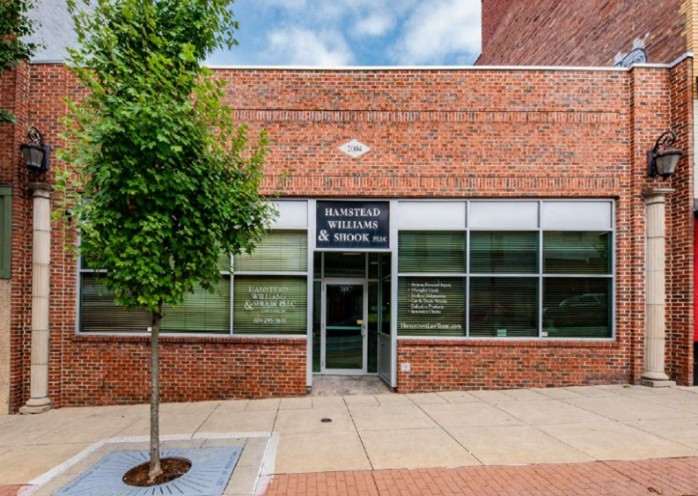
Façade Prior to Renovation
When we began envisioning the building as Desmone’s new Morgantown office, we saw an opportunity not simply to renovate, but to reawaken the structure. Our approach centered on opening the front of the space—allowing natural light to spill deep into the center of the plan and reestablishing a visual and experiential connection to the street.
By peeling back layers of enclosure and rethinking the interior massing, we transformed what had been a series of dark, cellular rooms into a dynamic, light-filled workplace. The redesigned façade presents a more modern expression while maintaining the integrity of the existing brickwork and storefront proportions—honoring the building’s mid-century origins while clearly signaling its next chapter.
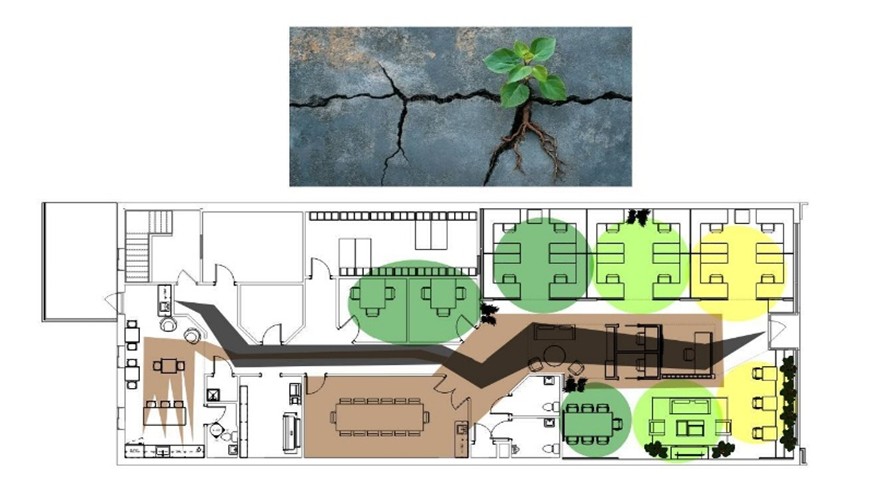
New Floor Plan “Growing from a Crack”

Central Phone Room Mass
As we worked through the design, a quiet metaphor began to take shape. Our interventions felt less like demolition and more like cultivation. The project reminded us of a scrappy little plant growing from a crack in the sidewalk — persistent, patient, and transformative. The reconfigured hallway, with its subtle shifts in angle, suggests that organic push outward. The central phone room mass and sculpted ceiling form a kind of stem and canopy, organizing the space while allowing active “leaves” of collaboration areas, meeting rooms, and workstations to branch off to either side. We did not set out to design a literal representation of growth, but the building’s evolution—through time and through our intervention—naturally led us there.
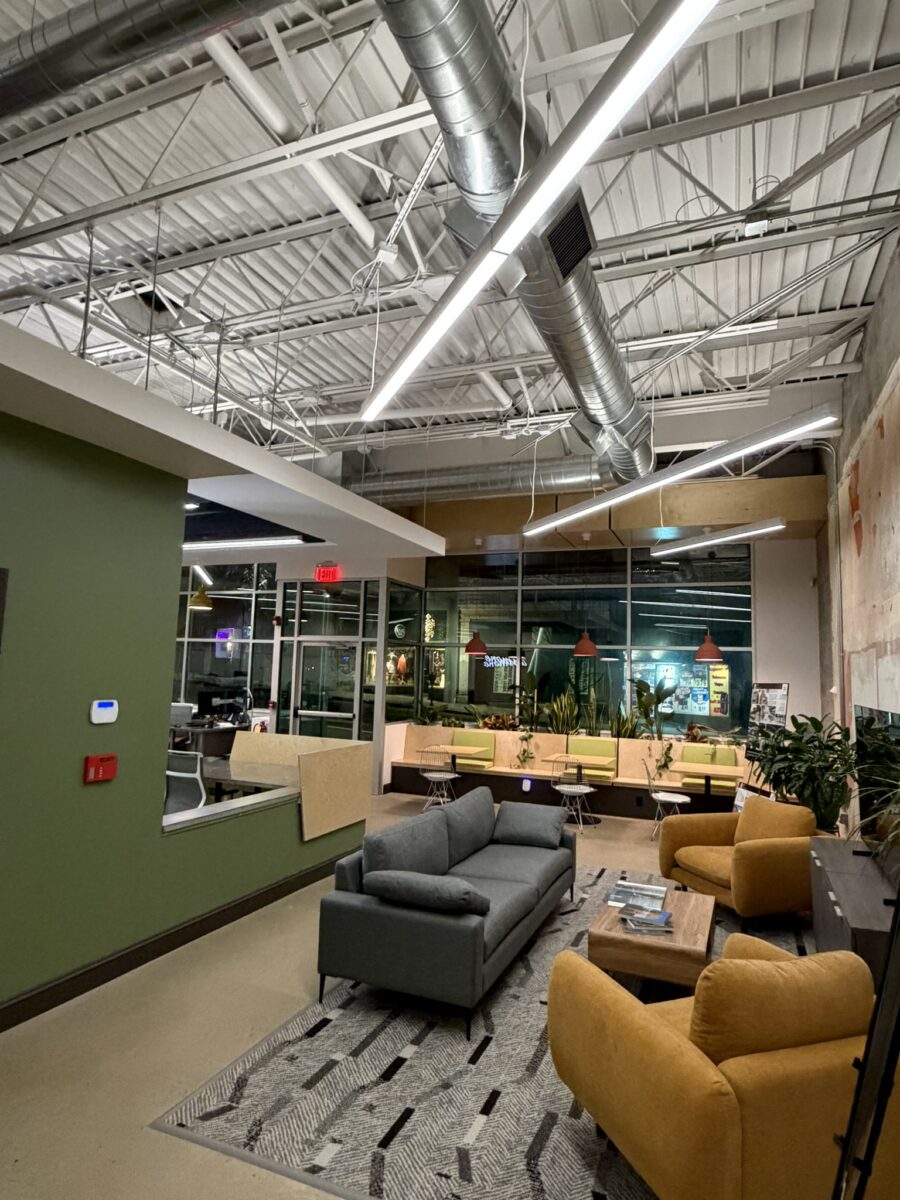
Collaboration Area
Integral to the transformation was a commitment to material reuse—both as a sustainability strategy and a practical approach to stewardship of the project budget. Wherever possible, existing elements were carefully salvaged and reimagined: solid-core wood doors and trim were refinished and reinstalled, acoustic ceiling tiles were selectively reused and refinished, original wood flooring was restored to anchor the existing spaces with warmth and history. Rather than viewing these materials as constraints, we treated them as assets—reducing construction waste, minimizing embodied carbon, and preserving the character embedded in the building itself. This layered approach allowed the renovation to be both environmentally responsible and cost-conscious, proving that adaptive reuse can deliver high design value while making smart use of available resources.

Renovated Façade
Today, the office feels porous and alive. Light penetrates the heart of the space. Activity is visible from the sidewalk. Conversations unfold within view of High Street rather than behind closed doors. The project is a study in adaptive reuse—not as nostalgia, but as momentum. By respecting what was there and strategically opening what was closed, we allowed the building to breathe again. Like that plant finding its way through concrete, the new Desmone office in Morgantown represents resilience, transformation, and the quiet power of thoughtful design to create room to grow.

